

Kēntasowin- Learning
As I start learning, I realized it's a lot harder to navigate, especially in a short time. My goal for my family and my late son is to pick up some of the language to help me connect back to my culture and my identity. I believe that language is healing, and this is a great way to begin healing and become more attuned with myself as an individual and a grieving mother. Within my reading in this course, I have come across the idea of using one's own motivation to obtain success in one's learning. I found that self-determination theory applied to me, as I was using the learning for enjoyment and a sense of accomplishment, while also learning for this class. I understand that I must be able to pull myself together and do it not for a purpose, but also because I have so much more to gain than just a grade in this class; I have hope to eventually be able to understand some of the language and be able to reconnect to many of the songs and histories by picking it up. In the article Chapter 8, Motivation, I understood that this is where I was at with regards to my own journey and learning the language for not only this class but also learning out of pure enjoyment and finding the importance within reclaiming my language for myself and my family.
Smart Goal
I will learn and correctly identify, pronounce, and use 30 household-item vocabulary words in Anishinaabemowin and be able to ask for these items specifically. I will master 30 household item words by demonstrating recognition, pronunciation, and recall of all vocabulary without labels or prompts. I will practice for 30 minutes each day using a combination of FHQ language apps, YouTube videos from Lorena Cote and Natalie Langan, and an Anishinaabemowin language book by Lynn Cote and Margaret Cote. By practicing household vocabulary daily, I will not only strengthen my everyday language skills but also increase my confidence in using Anishinaabemowin at home with my family. Within 3 weeks, I will master the 30 household-item words and be able to ask for each item specifically in my everyday life with my family.
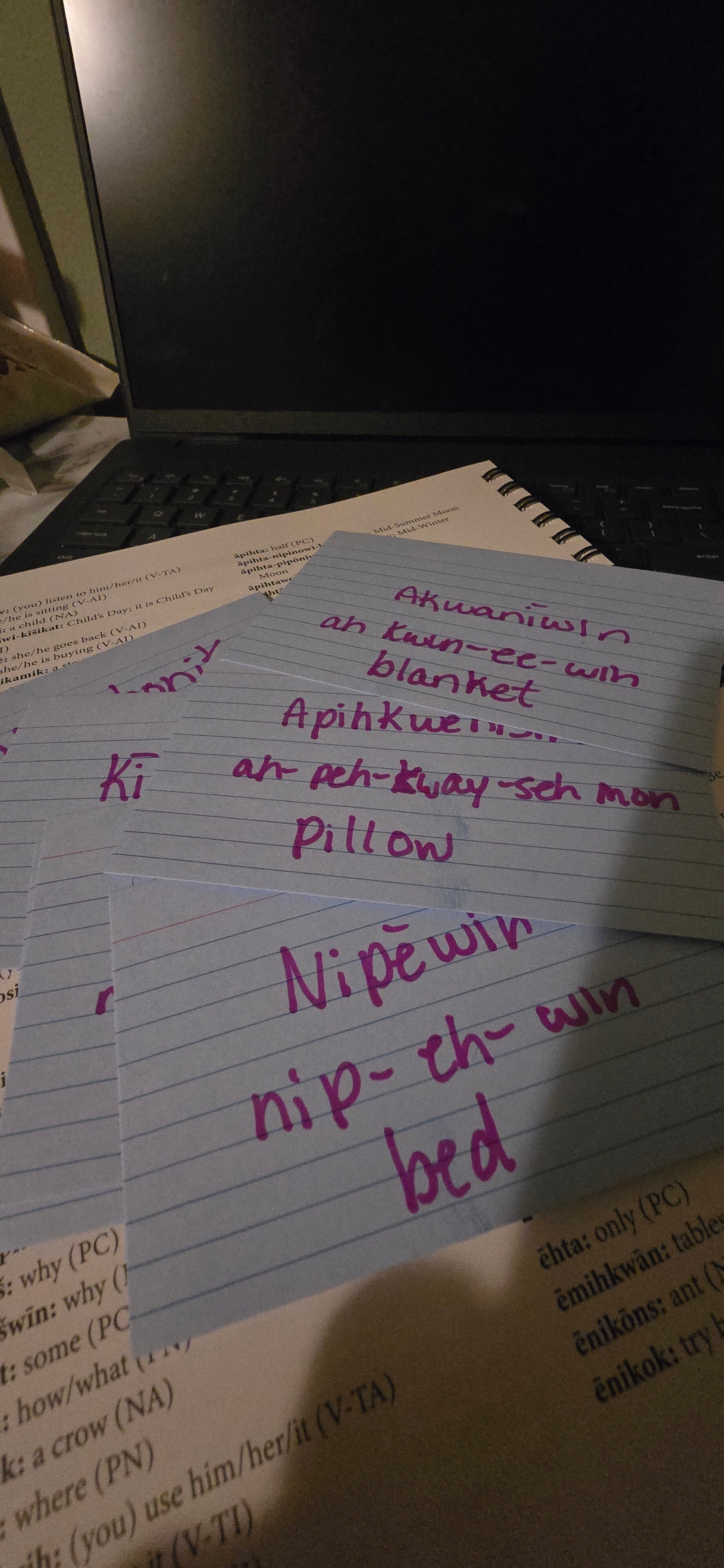
Week 1- July 3-10
Week 1: In the first week, I decided to focus on learning things around my house. I first chose things I used daily. I wanted to learn these 10 household items: pillow, blanket, table, door, towel, clock, sewing machine, book, and bed. I found that in the first few days, I struggled to remember to practice them when I saw them throughout the house. My mind was all over, and I really didn't make time to slow down and read them. Even when I had the phoneme along with the spelling of the word
.
Daily Routine
- 10 minutes: Study household items from Maci-Anihšinapemowin / Beginning Saulteaux by Margaret Cote & Lorena Lynn Cote. Writing these down in my learning journal and breaking down the phonemes for myself and family to read. I will also find a question to ask for an item.
- 10 minutes: Listen to and repeat pronunciation from Saulteaux App FHQ Education.
- When listening to the app, I found it beneficial that I wrote down the words in phoneme breakdown; I would read them out and try to say them faster than I did daily.
- 10 minutes: Review vocabulary using flashcards and working with someone to help me study these words this week. After this, write in journal/ blog about the learning session.
- Flashcards were used for memory, as well as spelling; I want to be able to identify the word as well as pronounce the word.

The app helped me daily; I spent an average of 5 to 8 minutes learning from it each day. I went through the words on my list, as they were all in the same section.
Spend 10 minutes on Language App

The learning journal was very hard to keep daily; I found myself just reading the words I had already written the day before. I documented my learning by writing in my journal.
Spend 10 minutes journaling

I think I enjoyed this the most because I did it with my girls. I would randomly ask them what a kisokan was. I spent the most time on this task.
Spend 10 minutes practicing flashcards
"Language learning is a journey, not a destination."
Jarrin Musqua
Week 2- Food Items
By the end of the week, I will learn 10 food items. I will learn the words sugar, milk, tea, bannock, soup, potatoes, meat, strawberries, eggs, and water. I will learn these with the assistance of the Saulteaux language App, flashcards, and a language book.
Daily Routine
- 10 minutes: I will study the new household items with assistance from Maci-Anihšinapemowin / Beginning Saulteaux by Margaret Cote & Lorena Lynn Cote. I will write the new words in my learning journal. I will find a new question to use for requesting an item.
The question was not obtainable this week. I had no way to learn this question. I will take this to my learning session with my father-in-law next week.
- 10 minutes: I will practice speaking and repeating pronunciation from the Saulteaux App, FHQ Education, and a YouTube video of fluent Anishinaabe speakers.
I watched 3 YouTube videos trying to find a way to ask for something; no luck, although I did practice other words this week.
- 10 minutes: I will review all 20 words through a matching game, flashcards and self-quizzing.
Flashcards were fun and an interactive way to learn the language.


I spent roughly 10 minutes a day practicing with the flashcards. I became quicker by Thursday.
Spend 10 minutes a day practicing

I spent roughly 6-7 minutes scanning book for questions to you with my assignment, requesting an item.
I spend 6-7 minutes of the day browsing the book looking for a question for an assignment

I spend 10 minutes practicing on the app, playing the games on there, focusing on the food section.
I spend 10 minutes a day praciting with the App

Week 3- July 17-22
I will learn 10 clothing items: shirt, pants, socks, moccasins, jacket, dress, purse, shoes, sweater, and hat.
Week 3: I will learn 10 clothing items: shirt, pants, socks, moccasins, jacket, dress, purse, shoes, sweater, and hat.
Daily Routine
- 10 minutes: I will write out the words and break down the sounds for the new 10 words. I will also look for my last question on requesting an item. I will write these in my learning journal for my reference.
- 10 minutes: I will listen to and repeat the pronunciation from the Saulteaux App FHQ Education, as well as from YouTube, when requesting an item I have learned.
- 10 minutes: review naming household items without prompts.
- I will journal/blog my learning each day to track my progress.

I will spend 10 minutes writing down the words into phonemes for myself.
I will spend 10 minutes writing/typing week 3 words.

I will practice with quizzes on the Saulteaux language app.
I will spend 10 minutes quizzing myself on app.

I will spend 10 minutes listening to the language. My father-in-law helped me with the words I could not find in the resources. He gave me proper use and pronunciation.
I will listen for 10 minutes of fluent speaker.
"The more individuals wish to learn a language because it is creating an enjoyable and meaningful activity, the more they are likely to learn the language."
-Lourdes Ortega